
OpenSandbox Kubernetes Controller
OpenSandbox Kubernetes Controller is a Kubernetes operator that manages sandbox environments through custom resources. It provides automated sandbox lifecycle management, resource pooling for fast provisioning, batch sandbox creation, and optional task orchestration capabilities in Kubernetes clusters.
Key Features
- Flexible Sandbox Creation: Choose between pooled and non-pooled sandbox creation modes
- Batch and Individual Delivery: Support both single sandbox (for real-user interactions) and batch sandbox delivery (for high-throughput agentic-RL scenarios)
- Optional Task Scheduling: Integrated task orchestration with optional shard task templates for heterogeneous task distribution and customized sandbox delivery (e.g., process injection)
- Resource Pooling: Maintain pre-warmed resource pools for rapid sandbox provisioning
- Pause and Resume: Persist sandbox filesystem state via rootfs snapshots, releasing cluster resources between sessions
- Comprehensive Monitoring: Real-time status tracking of sandboxes and tasks
Features
Batch Sandbox Management
The BatchSandbox custom resource allows you to create and manage multiple identical sandbox environments. Key capabilities include:
- Flexible Creation Modes: Support both pooled (using resource pools) and non-pooled sandbox creation
- Single and Batch Delivery: Create single sandboxes (replicas=1) or batches of sandboxes (replicas=N) as needed
- Scalable Replica Management: Easily control the number of sandbox instances through replica configuration
- Automatic Expiration: Set TTL (time-to-live) for automatic cleanup of expired sandboxes
- Optional Task Scheduling: Built-in task execution engine with support for optional task templates
- Detailed Status Reporting: Comprehensive metrics on replicas, allocations, and task states
Resource Pooling
The Pool custom resource maintains a pool of pre-warmed compute resources to enable rapid sandbox provisioning:
- Configurable buffer sizes (minimum and maximum) to balance resource availability and cost
- Pool capacity limits to control overall resource consumption
- Automatic resource allocation and deallocation based on demand
- Real-time status monitoring showing total, allocated, and available resources
Pod Eviction
Pool supports graceful pod eviction for scenarios like node maintenance or resource reclamation:
How it works:
- Users label a pod with
pool.opensandbox.io/evictto request eviction - The controller skips pods already allocated to BatchSandbox (protecting in-use workloads)
- Idle pods are deleted, triggering the pool to replenish capacity
- Pods marked for eviction are excluded from new allocations
Custom eviction behavior: You can implement custom eviction strategies by:
- Setting
pool.opensandbox.io/eviction-handlerlabel on the Pool to select your handler - Implementing the
EvictionHandlerinterface withNeedsEviction()andEvict()methods - Registering your handler in the factory function
Task Orchestration
Integrated task management system that executes custom workloads within sandboxes:
- Optional Execution: Task scheduling is completely optional - sandboxes can be created without tasks
- Process-Based Tasks: Support for process-based tasks that execute within the sandbox environment
- Heterogeneous Task Distribution: Customize individual tasks for each sandbox in a batch using shardTaskPatches
Process lifecycle hooks
Process tasks can define preStart and postStop exec hooks under spec.taskTemplate.spec.process.lifecycle:
spec:
  taskTemplate:
    spec:
      process:
        command: ["/bin/sh", "-c"]
        args: ["run-task"]
        lifecycle:
          preStart:
            exec:
              command: ["/bin/sh", "-c", "prepare-inputs"]
            timeoutSeconds: 30
          postStop:
            exec:
              command: ["/bin/sh", "-c", "persist-outputs"]
            timeoutSeconds: 30
preStart runs before the main process starts. A failed or timed-out hook prevents the main process from starting and is reported in the task status.
postStop is attempted whenever a task reaches a terminal state, including natural success or failure, preStart or process start failure, timeout, and task deletion. The task executor preserves the original terminal status and records the successful or failed hook outcome so a recorded postStop attempt is not repeated during later reconciliation or recovery. This makes the hooks suitable for staging files into a sandbox before execution and persisting outputs to a mounted volume after execution.
Advanced Scheduling
Intelligent resource management features:
- Minimum and maximum buffer settings to ensure resource availability while controlling costs
- Pool-wide capacity limits to prevent resource exhaustion
- Automatic scaling based on demand
Pause and Resume (Rootfs Snapshot)
OpenSandbox supports pause and resume for Kubernetes sandboxes by persisting the container root filesystem as an OCI image.
Time ---------------------------------------------------------------->

Sandbox lifecycle:   [Running]--[Pausing]--[Paused]--[Resuming]--[Running]
                         |                     |
                  commit rootfs          rewrite template images
                  push to registry       recreate runtime from snapshot
                  release pods/alloc
How it works
- Pause: The server patches
BatchSandbox.spec.pause=true. The controller creates an internalSandboxSnapshot, runs a commit Job on the same node, commits the container rootfs, and pushes it to the configured OCI registry. After the snapshot is ready, the controller transitions the sameBatchSandboxtoPausedand releases runtime Pods / pooled allocations. - Resume: The server patches
BatchSandbox.spec.pause=false. The controller reads the latestSandboxSnapshot, rewrites theBatchSandboxtemplate images to the snapshot image URIs, recreates the runtime, and transitions the sandbox back toRunning. The publicsandboxIdremains stable across pause/resume cycles.
WARNING
Current pause/resume support is limited to BatchSandbox.spec.replicas=1. The OpenSandbox server creates Kubernetes sandboxes with replicas: 1; direct BatchSandbox CRs with any other replica count are rejected by the controller pause entry because the internal pause snapshot records one source Pod's container images.
The SandboxSnapshot CRD
The SandboxSnapshot CR is the central resource for pause/resume lifecycle:
| Field | Location | Description |
|---|---|---|
spec.sandboxName | Spec | Target BatchSandbox name in the same namespace |
status.phase | Status | Pending -> Committing -> Succeed / Failed |
status.conditions | Status | Ready / Failed conditions with reason and message |
status.containers | Status | Committed image URIs per container |
status.sourcePodName | Status | Pod name resolved by controller |
status.sourceNodeName | Status | Node selected for the commit Job |
Prerequisites
- OCI Registry: An accessible container registry for storing snapshot images.
- Kubernetes Secrets: Docker config secrets for push and pull access.
- Controller configuration: Configure the controller manager with snapshot registry and secret flags.
- Controller RBAC: The controller requires
secrets: getpermission (included in the Helm chart andmake manifestsoutput).
Controller Configuration
The snapshot controller supports the following command-line flags:
| Flag | Default | Description |
|---|---|---|
--snapshot-registry | "" | OCI registry prefix used for snapshot images |
--snapshot-push-secret | "" | Secret name used by commit Jobs to push snapshots |
--image-committer-pod-template-file | "" | Path to a PodTemplateSpec overlay for image-committer commit Job Pods |
--resume-pull-secret | "" | Secret name injected into resumed sandboxes for image pulls |
--image-committer-image | image-committer:dev | Image used for commit operations |
--commit-job-timeout | 10m | Timeout duration for commit jobs |
--snapshot-registry-insecure | false | Pass insecure registry mode to snapshot commit Jobs |
These flags are configured at controller startup. The built-in image committer uses containerd APIs directly. Any custom image-committer-image must implement the documented commit and unpause command contract and must be trusted: commit Jobs mount the host containerd socket on the source node, so the image effectively has node-level runtime access. Pin the image by digest or enforce a trusted registry/admission policy in production.
The optional Pod template is operator-controlled and can supply identity metadata, a ServiceAccount, resources, scheduling settings, and additional containers while the controller preserves the commit runtime invariants.
Quick Setup
# Create push secret
kubectl create secret docker-registry registry-snapshot-push-secret \
  --docker-server=<your-registry> \
  --docker-username=<user> \
  --docker-password=<token>

# Create pull secret (can reuse push secret)
kubectl create secret docker-registry registry-pull-secret \
  --docker-server=<your-registry> \
  --docker-username=<user> \
  --docker-password=<token>
Then configure the controller manager with:
- --snapshot-registry=<your-registry>/sandboxes
- --snapshot-registry-insecure=true # only for HTTP/self-signed local registries
- --snapshot-push-secret=registry-snapshot-push-secret
- --resume-pull-secret=registry-pull-secret
INFO
Snapshot image retention is registry-managed. Deleting a SandboxSnapshot removes the Kubernetes commit/unpause Jobs, but it does not delete pushed OCI images from the registry. Configure registry retention/GC for tags such as snap-gen<N> according to your environment.
Getting Started
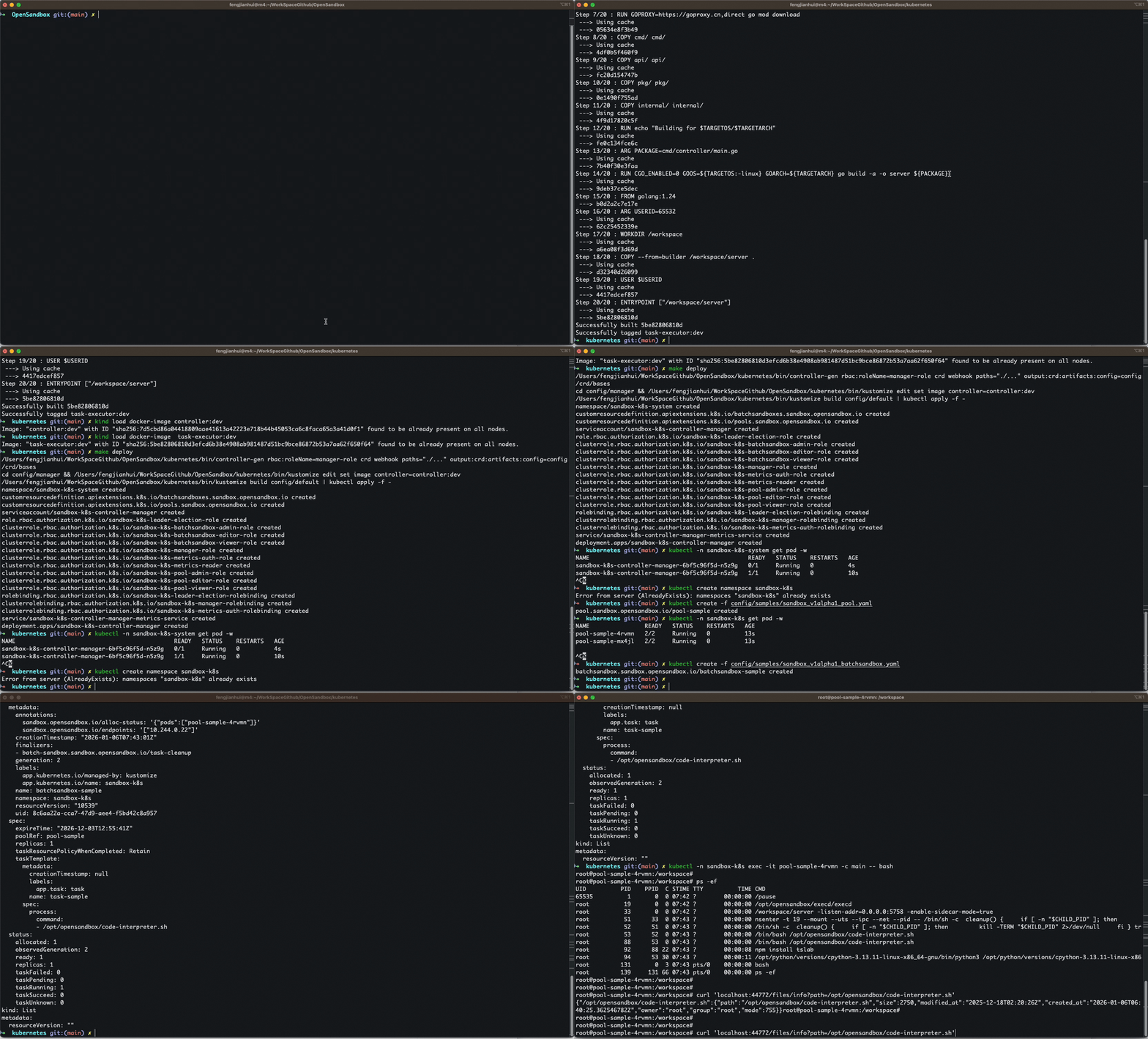
Prerequisites
- go version v1.24.0+
- docker version 17.03+
- kubectl version v1.11.3+
- Access to a Kubernetes v1.21.1+ cluster
If you don't have access to a Kubernetes cluster, you can use kind to create a local Kubernetes cluster for testing purposes. Kind runs Kubernetes nodes in Docker containers, making it easy to set up a local development environment.
To install kind:
- Download the release binary for your OS from the releases page and move it into your
$PATH - Or use a package manager:
- macOS (Homebrew):
brew install kind - Windows (winget):
winget install Kubernetes.kind
- macOS (Homebrew):
After installing kind, create a cluster with:
kind create clusterKind Users
If you're using a kind cluster, you need to load the controller and task-executor images into the kind node after building them with make docker-build. Kind runs Kubernetes nodes in Docker containers and cannot directly access images from your local Docker daemon.
kind load docker-image <controller-image-name>:<tag>
kind load docker-image <task-executor-image-name>:<tag>
Deployment
This project requires two separate images - one for the controller and another for the task-executor component.
Option 1: Deploy with Helm (Recommended)
Install from GitHub Release:
You can install OpenSandbox Controller directly from GitHub Releases. Check the Releases page for all available versions.
The controller chart no longer bundles the CRDs. Install the base chart once per cluster before the controller:
shhelm install base \ https://github.com/opensandbox-group/OpenSandbox/releases/download/helm/base/<version>/base-<version>.tgz
# Replace <version> with the desired version (e.g., 0.1.0)
helm install opensandbox-controller \
  https://github.com/opensandbox-group/OpenSandbox/releases/download/helm/opensandbox-controller/<version>/opensandbox-controller-<version>.tgz \
  --namespace opensandbox-system \
  --create-namespace
Customize Installation:
Use --set flags to customize the configuration:
helm install opensandbox-controller \
  https://github.com/opensandbox-group/OpenSandbox/releases/download/helm/opensandbox-controller/0.1.0/opensandbox-controller-0.1.0.tgz \
  --namespace opensandbox-system \
  --create-namespace \
  --set controller.replicaCount=2 \
  --set controller.resources.limits.cpu=1000m \
  --set controller.resources.limits.memory=512Mi
Or use a values file for complex configurations:
cat > custom-values.yaml <<EOF
controller:
  replicaCount: 2
  resources:
    limits:
      cpu: 1000m
      memory: 512Mi
    requests:
      cpu: 100m
      memory: 128Mi
  logLevel: debug
EOF

helm install opensandbox-controller \
  https://github.com/opensandbox-group/OpenSandbox/releases/download/helm/opensandbox-controller/0.1.0/opensandbox-controller-0.1.0.tgz \
  --namespace opensandbox-system \
  --create-namespace \
  -f custom-values.yaml
Install from source (for development):
Build and push your images:
shcd kubernetes make docker-build docker-push CONTROLLER_IMG=<some-registry>/opensandbox-controller:tag make docker-build-task-executor docker-push-task-executor TASK_EXECUTOR_IMG=<some-registry>/opensandbox-task-executor:tagInstall with Helm:
shhelm install base ../manifests/charts/base helm install opensandbox-controller ../manifests/charts/controller \ --set controller.image.repository=<some-registry>/opensandbox-controller \ --set controller.image.tag=<tag> \ --namespace opensandbox-system \ --create-namespace
Verify Installation:
kubectl get pods -n opensandbox-system
kubectl get deployment -n opensandbox-system
kubectl logs -n opensandbox-system -l control-plane=controller-manager -f
Upgrade:
helm upgrade opensandbox-controller \
  https://github.com/opensandbox-group/OpenSandbox/releases/download/helm/opensandbox-controller/<new-version>/opensandbox-controller-<new-version>.tgz \
  --namespace opensandbox-system
Uninstall:
helm uninstall opensandbox-controller -n opensandbox-systemOption 2: Deploy with Kustomize
Build and push your images:
shmake docker-build docker-push CONTROLLER_IMG=<some-registry>/opensandbox-controller:tag make docker-build-task-executor docker-push-task-executor TASK_EXECUTOR_IMG=<some-registry>/opensandbox-task-executor:tagInstall the CRDs into the cluster:
shmake installDeploy the Manager to the cluster:
shmake deploy CONTROLLER_IMG=<some-registry>/opensandbox-controller:tag
WARNING
make deploy only rewrites the controller image. Build and publish TASK_EXECUTOR_IMG separately if your Pool / BatchSandbox templates refer to it. You may also need cluster-admin privileges before running the commands.
Creating BatchSandbox and Pool Resources
Basic Example
Create a simple non-pooled sandbox without task scheduling:
apiVersion: sandbox.opensandbox.io/v1alpha1
kind: BatchSandbox
metadata:
  name: basic-batch-sandbox
spec:
  replicas: 2
  template:
    spec:
      containers:
      - name: sandbox-container
        image: nginx:latest
        ports:
        - containerPort: 80
Apply and check status:
kubectl apply -f basic-batch-sandbox.yaml
kubectl get batchsandbox basic-batch-sandbox -o wide
After the sandboxes are ready, find the endpoint information in the annotations:
kubectl get batchsandbox basic-batch-sandbox -o jsonpath='{.metadata.annotations.sandbox\.opensandbox\.io/endpoints}'Pooled Sandbox Without Task
First, create a resource pool:
apiVersion: sandbox.opensandbox.io/v1alpha1
kind: Pool
metadata:
  name: example-pool
spec:
  template:
    spec:
      containers:
      - name: sandbox-container
        image: nginx:latest
        ports:
        - containerPort: 80
  capacitySpec:
    bufferMax: 10
    bufferMin: 2
    poolMax: 20
    poolMin: 5
The pool buffer counts only unallocated pods that are Ready. Pods that are still starting count toward the pool's total capacity, but are not advertised as available buffer.
Optional: add scaleStrategy to limit the size of each scale-up and scale-down batch (the default is 25%):
  scaleStrategy:
    maxUnavailable: "20%"  # or absolute number like 5
The controller waits for a scale-down batch to finish terminating before it starts another scaling batch.
Create a batch of sandboxes using the pool:
apiVersion: sandbox.opensandbox.io/v1alpha1
kind: BatchSandbox
metadata:
  name: pooled-batch-sandbox
spec:
  replicas: 3
  poolRef: example-pool
Lifecycle Pool requests start an execd task
The example above allocates warm nginx pods and is useful when the container's own service is the workload. A BatchSandbox created directly without a taskTemplate keeps this allocation-only behavior.
The lifecycle API creates sandboxes intended for interactive SDK use, so every Pool request creates a per-allocation taskTemplate. If the request omits an entrypoint, the task uses the default tail -f /dev/null keepalive.
A Pool used through the lifecycle API must run task-executor on port 5758, provide executable /opt/opensandbox/bootstrap.sh and /opt/opensandbox/execd files (or set EXECD to another installed execd binary), and include /bin/sh plus tail for the default keepalive. It must not start another execd on port 44772 before allocation. The plain nginx Pool in this example and Pools that prestart execd without task-executor do not satisfy this on-demand task contract.
runtime.execd_run_as_init controls only the task process topology. In both modes the task runs bootstrap as its root process so it remains alive until sandbox cleanup. When it is true, it additionally injects EXECD_INIT=1.
Pool capacity back-pressure
When a lifecycle request cannot obtain a slot because the selected Pool is at poolMax, the controller records PoolAllocationPending=True with reason PoolCapacityExhausted on the BatchSandbox. The Server waits up to kubernetes.pool_acquisition_timeout_seconds (30 seconds by default), without extending the overall sandbox creation timeout. If capacity remains unavailable, the request returns HTTP 429, error code KUBERNETES::POOL_CAPACITY_EXHAUSTED, and a Retry-After header. A slot released during the acquisition window can still satisfy the request. Capacity-blocked time accumulates across polls, so brief status transitions do not make the final error depend on the last observed status.
Per-request network policies
Pool pods are created before allocation. The lifecycle API therefore rejects networkPolicy together with extensions.poolRef; it cannot inject an egress sidecar into an existing pool pod. Configure required network controls in the Pool pod template before pods are created, or use a non-pooled sandbox for per-request policies.
Entrypoint and environment injection
Pool pods are also created before a lifecycle request supplies its entrypoint or environment variables. The server does not rewrite the allocated Pod's command, args, or env; seeing the original Pool template in the Pod YAML is expected. Instead, it writes the request-specific process to BatchSandbox.spec.taskTemplate, and the controller sends that task to an in-pod task-executor on port 5758.
A Pool used through the lifecycle API must therefore run task-executor, provide an executable /opt/opensandbox/bootstrap.sh, and install execd at /opt/opensandbox/execd or set EXECD to another installed execd binary. When no entrypoint is supplied, the server places its default keepalive in the task rather than inheriting the Pool container command. See the Code Interpreter Pool example for a complete template and troubleshooting commands.
Shared storage in Pool mode
Static shared storage follows the same rule: pre-create a PVC (normally with a ReadWriteMany-capable storage class) and mount it in the Pool pod template as shown in the complete example linked below. The Kubernetes controller preserves these static mounts when it creates warm pods from the Pool template. Per-sandbox volumes cannot be combined with extensions.poolRef, because an allocated warm pod cannot gain new volumes. See the Kubernetes PVC guide.
Pooled Sandbox with Heterogeneous Tasks
Create a batch of sandboxes with process-based heterogeneous tasks. For task execution to work properly, the task-executor must be deployed as a sidecar container in the pool template and share the process namespace with the sandbox container:
apiVersion: sandbox.opensandbox.io/v1alpha1
kind: Pool
metadata:
  name: task-example-pool
spec:
  template:
    spec:
      shareProcessNamespace: true
      containers:
      - name: sandbox-container
        image: ubuntu:latest
        command: ["sleep", "3600"]
      - name: task-executor
        image: <task-executor-image>:<tag>
        securityContext:
          capabilities:
            add: ["SYS_PTRACE"]
  capacitySpec:
    bufferMax: 10
    bufferMin: 2
    poolMax: 20
poolMin: 5apiVersion: sandbox.opensandbox.io/v1alpha1
kind: BatchSandbox
metadata:
name: task-batch-sandbox
spec:
replicas: 2
poolRef: task-example-pool
taskTemplate:
spec:
process:
command: ["echo", "Default task"]
shardTaskPatches:
- spec:
process:
command: ["echo", "Custom task for sandbox 1"]
- spec:
process:
command: ["echo", "Custom task for sandbox 2"]
args: ["with", "additional", "arguments"]Monitoring Resources
kubectl get pools
kubectl get batchsandboxes
kubectl describe pool example-pool
kubectl describe batchsandbox example-batch-sandbox
Understand BatchSandbox status
A BatchSandbox reports sandbox availability and optional task execution separately. Use status.phase, status.conditions, and the replica counters for the sandbox runtime. Use the status.task* counters for task progress and completion.
Succeed is not task completion
status.phase: Succeed is the steady running phase. The controller sets it after observing at least one non-deleting Pod that is Running and Ready. It is non-terminal and does not mean that a task, Pod, or Kubernetes Job completed successfully.
For a BatchSandbox with multiple replicas, Succeed also does not mean that every desired replica is Ready.
status.phase | Meaning |
|---|---|
Pending | The controller has not observed a Running and Ready sandbox Pod yet. Scheduling waits and retryable image-pull states remain Pending. |
Succeed | At least one sandbox Pod is Running and Ready; the sandbox is available. |
Pausing | A pause operation is in progress. |
Paused | The sandbox is paused and its runtime resources have been released. |
Resuming | The controller is restoring runtime resources after a pause. |
Failed | The controller detected a terminal sandbox runtime failure. A Pod in Kubernetes phase Failed is terminal; inspect conditions and Pod events for details. A Pod still in phase Running is also treated as terminal when its restart policy is Never and its main container (the first container in the Pod spec) has exited with a non-zero code — for example when a sidecar keeps the Pod running after the sandbox main process crashed. |
The controller records active conditions with status: "True":
| Condition | Meaning when True |
|---|---|
Ready | The phase is Succeed; reason PodsReady means the sandbox is running. |
Progressing | The sandbox is being created, paused, or resumed. |
Paused | The sandbox is fully paused. |
PauseFailed, ResumeFailed, PodFailed | The corresponding operation or runtime failed; inspect reason and message. A terminal init-container or container exit is summarized on PodFailed. |
status.taskFailed remains the number of failed optional tasks. Pod or init-container failures are reported through status.phase and PodFailed; they do not overwrite task counters. During synchronous sandbox creation, the Server converts a terminal Failed phase into KUBERNETES::POD_FAILED immediately instead of waiting for the Pod readiness timeout.
Treat a condition as satisfied only when the matching entry exists with status: "True". Check status.observedGeneration against metadata.generation before acting on status after a spec update.
Inspect runtime and task status together:
kubectl get batchsandbox example-batch-sandbox \
  -o custom-columns='NAME:.metadata.name,GEN:.metadata.generation,OBSERVED:.status.observedGeneration,PHASE:.status.phase,READY:.status.ready,DESIRED:.spec.replicas,TASK_RUNNING:.status.taskRunning,TASK_SUCCEED:.status.taskSucceed,TASK_FAILED:.status.taskFailed'

kubectl get batchsandbox example-batch-sandbox \
  -o jsonpath='{range .status.conditions[*]}{.type}{"="}{.status}{"\t"}{.reason}{"\t"}{.message}{"\n"}{end}'
Choose monitoring fields based on the question you need to answer:
| Monitoring goal | Fields to evaluate |
|---|---|
| At least one sandbox is available | A Ready=True condition, normally with status.phase=Succeed |
| All desired replicas are Ready | A fresh status where status.ready == spec.replicas |
| Tasks have completed | taskPending, taskRunning, taskSucceed, taskFailed, and taskUnknown, according to the workload's completion policy |
Performance
When both use resource pools, the total time comparison for delivering 100 Sandboxes:
| Test Scenario | Total Time (seconds) |
|---|---|
| SIG Agent-Sandbox (concurrency=1) | 76.35 |
| SIG Agent-Sandbox (concurrency=10) | 23.17 |
| SIG Agent-Sandbox (concurrency=50) | 33.85 |
| BatchSandbox | 0.92 |
The time complexity of SIG Agent-Sandbox and BatchSandbox for batch delivery of N Sandboxes is O(N) and O(1) respectively.
Project Structure
kubernetes/
  api/v1alpha1/          # Custom resource definitions (BatchSandbox, Pool)
  cmd/controller/        # Main controller manager entry point
  cmd/task-executor/     # Task executor binary
  config/crd/            # CRD manifests
  config/manager/        # Controller manager configuration
  config/rbac/           # RBAC manifests
  config/samples/        # Sample YAML manifests
  internal/controller/   # Core controller implementations
  internal/scheduler/    # Resource allocation and scheduling logic
  internal/task-executor/# Task execution engine internals
  pkg/task-executor/     # Shared task executor packages
  test/                  # Test suites and utilities
License
This project is open source under the Apache 2.0 License.