
Lifecycle Server
The server is the control plane of an OpenSandbox deployment: one authenticated HTTP API that every SDK, CLI, and MCP client talks to, regardless of what runs the sandboxes. It validates requests, enforces access control, persists server-managed records, and delegates the actual sandbox work to a configured runtime backend — Docker, Kubernetes, or the Fast Sandbox integration.
Capabilities at a glance
| Capability | What you get |
|---|---|
| One lifecycle API | Create (from image, snapshot, or template), pause, resume, delete, renew expiration — identical across backends |
| Asynchronous creation | Requests return immediately with Pending; clients poll status or use SDK readiness helpers |
| Endpoint resolution | A resolved address for any sandbox port — direct, via ingress gateway, or through the server proxy |
| Access control | API-key authentication with startup guardrails against insecure misconfiguration |
| Persistence | Server-managed records in SQLite (default) or PostgreSQL |
| Observability | Status with state / reason / message, plain-text diagnostics, OpenTelemetry metrics |
Lifecycle semantics
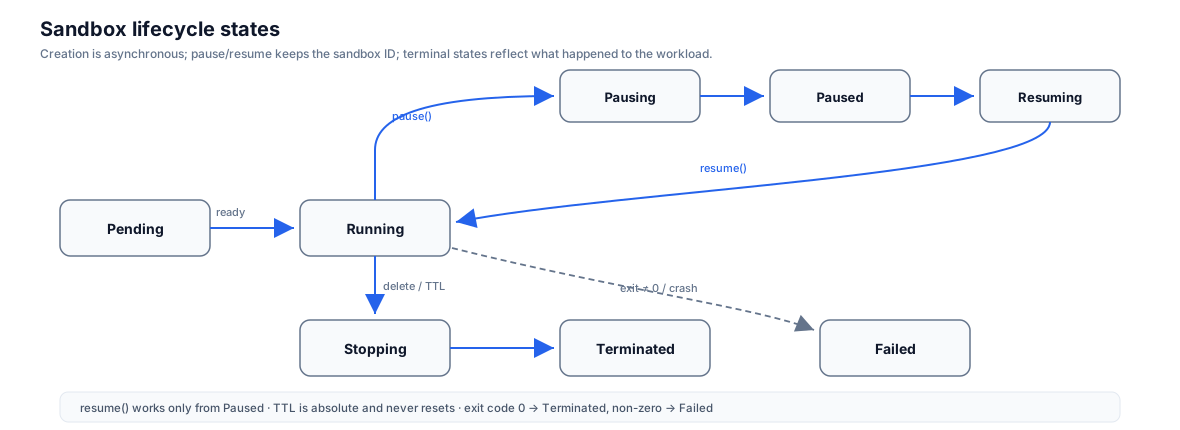
Creation is asynchronous: the API returns before the sandbox is running. Expiration is an absolute TTL — server or runtime restarts do not reset it.
resume() is a pause-state operation, never a general restart: a workload that already exited is Terminated (exit code 0) or Failed (non-zero), and the honest answer to that is a replacement sandbox. Pausing on Kubernetes keeps the sandbox ID and restores the root filesystem — with the opt-in QEMU mode, even guest memory. See Pause & Resume.
Architecture
The server is a FastAPI application organized in layers, each replaceable behind an interface:
- API layer (
api/) — thin HTTP routers: lifecycle, proxy, pool, templates, network policy, diagnostics, metrics. Request and response schemas live beside them, and all validation happens here. - Middleware (
middleware/) — cross-cutting concerns: API-key authentication, request IDs, date headers, HTTP metrics. - Service layer (
services/) — the lifecycle state machines. OneSandboxServiceinterface with per-runtime implementations; under Kubernetes,CompositeSandboxServicecomposes the container workload provider withFastSandboxService(atemplateIdcreate or anfsb-ID routes to Fast Sandbox). Backend specifics never leak past the interface, which is why the API layer stays thin. - Repositories (
repositories/) — persistence for server-managed records only: snapshot metadata and the template catalog, each with SQLite and PostgreSQL adapters plus a migration path between them. - Integrations (
integrations/) — optional add-ons, such as the renew-on-access consumers (server proxy events, ingress events via Redis).
Two rules follow from the layering. The API never talks to a runtime directly — everything goes through a service. And sandboxes themselves are never stored in the server's database: the Docker container, the Kubernetes resources, or the fast-sandbox CRs are the source of truth. The server persists only what it owns, which is what makes the storage backend swappable and failover tractable at all.
Endpoints and proxying
GET /sandboxes/{id}/endpoints/{port} returns a reachable address for a sandbox service. Depending on runtime and configuration it is:
- a direct address (Docker host mapping or pod IP),
- an ingress gateway route (header, URI, or wildcard form, with secure-access headers when enabled), or
- a server-proxied URL — the server forwards HTTP and WebSocket to the sandbox itself.
The proxy preserves the backend's status codes, bodies, and repeated headers (including each Set-Cookie), strips hop-by-hop headers, and reports a failed backend as 502 with error code BACKEND_CONNECTION_FAILED — use the code, not the message, to classify failures. secureAccess is currently a Kubernetes ingress-gateway feature only.
Runtimes
One SandboxService interface, three implementations:
| Runtime | Selection | Notes |
|---|---|---|
| Docker | runtime.type = "docker" | Local and single-host deployments |
| Kubernetes | runtime.type = "kubernetes" | Container workloads via the controller or agent-sandbox |
| Fast Sandbox | Part of the Kubernetes composition | Template-backed sandboxes (templateId create, fsb- IDs) — see Fast Sandbox |
Backend-specific behavior stays behind the service boundary: the API, response models, and SDKs are identical across all three.
Docker deletion
Deletion synchronously removes the application, stops and removes its egress sidecar, then cleans up volumes. Docker allows 9 seconds for egress shutdown before forced termination; the full request can take longer. If application removal fails, dependent resources and metadata are kept for retry — TTL cleanup retries after 30 seconds without changing the expiration. Sidecar cleanup is best effort, so a 404 does not guarantee that every resource is gone.
Storage and high availability
Server-managed records — snapshot metadata and the template catalog — persist to SQLite by default, or PostgreSQL when [store] type = "postgresql" is set (DSN injected via environment):
[store]
type = "postgresql"

[store.postgresql]
min_pool_size = 1
max_pool_size = 10
snapshot_recovery_interval_seconds = 15
What HA means here — and what it does not
- The default deployment is single-active: one server replica,
Recreateupgrade strategy, brief API interruption during upgrades. SQLite fits this mode. - PostgreSQL does not turn the server into a horizontally scaled API. It enables one narrowly scoped multi-replica capability: two replicas coordinating public snapshot creation on the Kubernetes runtime. The chart still defaults to one replica; a second replica is opt-in and only meaningful with PostgreSQL plus the Kubernetes runtime.
- General multi-replica API HA — load-balanced lifecycle traffic — is not supported yet.
How two replicas coordinate snapshots
The normal path needs no coordination at all. The creating replica writes a non-terminal row, then watches the deterministic-named SandboxSnapshot CR; every observed status change converges the database row through the same conditional write — an UPDATE guarded by the expected prior state, so whichever observation arrives last wins and concurrent writers cannot corrupt the record. On a single replica, this plus a one-time scan for unfinished rows at startup is the whole story.
The mechanisms below cover only what the watch cannot: a peer that never watched the creating replica's namespace, a lost create race, and a crashed writer. The design deliberately avoids leases and leader election; it rides on two existing invariants — the CR name is deterministic, and the Kubernetes API is already a serialized, watchable store.
- Observe before create. A replica checks for the deterministic-named
SandboxSnapshotCR before creating it. If a peer already created it, the replica converges on that CR — including one a peer has already finished — instead of creating a duplicate. A genuine create race is absorbed as409 AlreadyExistsand treated as success. - CAS on the terminal write. The terminal database result is written conditionally on the expected prior state, so when two replicas race to finish the same snapshot, one wins and the other's write is a no-op.
- Recovery scans. A crashed replica leaves its snapshot row non-terminal. The surviving replica re-scans unfinished rows every
snapshot_recovery_interval_secondsand drives them to completion through the same CR observation, so a crash or a transient Kubernetes timeout leaves the row recoverable rather than failed.
No exactly-once guarantee is claimed across the database, Kubernetes, and the image registry — the recovery interval shapes peer-takeover latency, not atomicity. Snapshot execution on Docker + SQLite keeps single-process recovery semantics. For Secret and Helm wiring of the two-replica topology, see Kubernetes Deployment.
Authentication
Every endpoint except health and documentation requires the OPEN-SANDBOX-API-KEY header when an API key is configured. The server refuses to start unconfigured in non-interactive environments unless insecurity is explicitly acknowledged — production deployments should always set a key.
Observability
The server exports OTLP metrics for HTTP request duration (by matched route, never raw paths or identifiers) and sandbox creation outcomes. Diagnostics routes return plain-text runtime and event information for operators and AI troubleshooting workflows. Configuration reference: server configuration.