
Storage
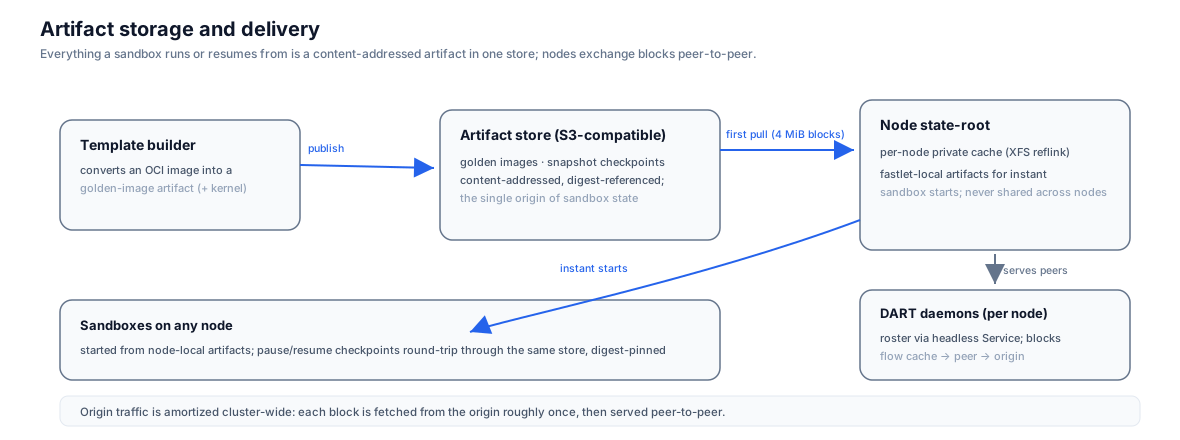
Fast Sandbox reduces storage to one shape: everything a sandbox runs or resumes from is a content-addressed artifact in a single S3-compatible store. Golden images, pause checkpoints, and snapshots are all artifacts, referenced by manifest digest — never mutated, always verifiable.
Where artifacts come from
- Template builds convert an OCI image (plus guest wiring and, for microVM runtimes, a kernel) into a golden-image artifact and publish it; the SandboxTemplate CR records the manifest reference and digest (see Templates).
- Pause checkpoints and snapshots are written by the same machinery: the runtime state is captured, pushed, and recorded digest-first in the SandboxSnapshot CR (see Pause, Resume, and Snapshots). Resume never trusts a mutable tag.
Where artifacts go
Nodes keep a private state root — an XFS-reflink-backed cache local to each node, never shared between nodes. This is deliberate: a fastlet's instant starts come from node-local artifacts, and cross-node state sharing would turn every node into part of every other node's failure domain.
The cost of private caches is duplicate downloads, and that is what DART eliminates: a node-local delivery daemon per node, peer-aware through a headless Service roster. Block-level fetches (4 MiB) follow cache → peer → origin — each block is fetched from the origin roughly once cluster-wide, then served peer-to-peer. Per-node block source counters make the delivery path observable.
What is deliberately not stored
- Egress credentials stay memory-only in the egress process — pushed per subject over the proxy route, never written to a Secret volume or disk.
- Sandbox runtime writes (files a sandbox created) live in the sandbox's own slice; they are captured only when an explicit checkpoint or snapshot says so. Storage for sandboxes is an act of the lifecycle, not a background sync.
- Routing and policy state lives in the CRDs, not in the artifact store — the store carries bytes, the cluster carries meaning.
Operating it
The artifact store is plain S3-compatible object storage; capacity planning reduces to artifact sizes and retention. Deleting a SandboxSnapshot record does not delete the pushed artifacts — retention and cleanup of the store are operator policy, kept outside the sandbox lifecycle on purpose.
Prepare the node state disk
The fast-sandbox chart mounts runtime.stateRoot from the host (default /var/lib/fast-sandbox/firecracker). DirectoryOrCreate creates a directory on the existing filesystem; it does not provision a separate disk. When using the opensandbox umbrella chart, set fast-sandbox.runtime.stateRoot. Set the chart value to the same directory used as the helper's mountpoint. Prepare this mount before deploying the runtime DaemonSet on each node. Otherwise, drain the node's sandboxes and restart the runtime Pods after mounting: an already-running container may continue seeing the old filesystem.
Prefer a dedicated XFS data disk with reflink enabled. For a new, empty device, after verifying its identity and that it contains no required data:
sudo mkfs.xfs -m reflink=1 /dev/vdb
sudo mkdir -p /var/lib/fast-sandbox/firecracker
sudo mount -o noatime /dev/vdb /var/lib/fast-sandbox/firecracker
sudo blkid /dev/vdb
Persist the mount in /etc/fstab using the device's UUID. Formatting destroys the device's contents; never run these commands on an existing state disk. Keep the mountpoint empty before mounting so existing state is not hidden.
When no extra device is available, the repository provides scripts/fast-sandbox-state-root-setup.sh:
bash scripts/fast-sandbox-state-root-setup.sh --dry-run 50G
sudo bash scripts/fast-sandbox-state-root-setup.sh 50G
# Optional: SIZE MOUNTPOINT BACKING_FILE
sudo bash scripts/fast-sandbox-state-root-setup.sh 100G /data/firecracker /data/firecracker.xfs
The helper allocates a new backing file, formats it with XFS reflink=1, mounts it with loop,noatime, and verifies an actual reflink copy. It requires Linux, xfsprogs, GNU coreutils, and util-linux. It refuses existing backing files, symlinked paths, mounted targets, and nonempty mountpoints. It prints an fstab entry for review; it does not edit fstab or restart workloads. On failure, it retains any created backing file for inspection instead of risking deletion of mounted data. Inspect findmnt and losetup -j BACKING_FILE before cleanup or retry.
Unlike a sparse file, the helper uses fallocate to reserve the requested space and checks that at least another 10 GiB remains on the backing filesystem. This is a point-in-time check, not a host-wide reservation: other workloads can still fill that filesystem, and thin-provisioned storage needs its own capacity monitoring. A dedicated disk avoids coupling the state cache to root-disk usage.
Capacity and readiness
Budget for every distinct cached template's rootfs plus guest-memory snapshot, active sandbox writable data, and cache overhead. Start with at least 50% workload headroom and keep more than 10 GiB free on the state filesystem (the default host-readiness floor). The helper's minimum volume size is 11 GiB; that is not a production sizing recommendation. Reflink saves initial copying but subsequent writes still allocate blocks.
Old template artifacts are not automatically reclaimed just because a template version changes. Track disk usage, retire unused templates, drain sandboxes using them, and stop the node runtime before manually reconciling its local caches. Do not delete live images, cache, or jails directories. Preserve any state needed for recovery, and expect artifacts to be downloaded again after cleanup.
After provisioning, verify the filesystem and the runtime's readiness report:
# Use your configured runtime.stateRoot (for example /data/firecracker):
STATE_ROOT=/var/lib/fast-sandbox/firecracker
findmnt -M "$STATE_ROOT"
df -h "$STATE_ROOT"
sudo xfs_info "$STATE_ROOT"   # expect reflink=1
kubectl -n opensandbox-system get daemonsets
# Use the deployed Firecracker runtime DaemonSet name:
kubectl -n opensandbox-system rollout restart daemonset/<runtime-daemonset>
kubectl -n opensandbox-system logs daemonset/<runtime-daemonset> --all-containers --tail=100
The stateroot-filesystem check should report type xfs and reflink CoW supported. Insufficient free space fails readiness and can remove the Firecracker scheduling labels; missing reflink support warns and falls back to full rootfs copies. A healthy state disk alone does not guarantee readiness: KVM, memory, and runtime assets must also pass their checks.