
Fast Sandbox Integration
Fast Sandbox is a runtime backend that connects OpenSandbox to the external fast-sandbox platform. It provisions template-backed sandboxes — containers, gVisor, Kata, or Firecracker microVMs — inside pre-warmed Fastlet pods, removing the per-sandbox Kubernetes scheduler, watch propagation, and kubelet path from the creation hot path.
The adapter and endpoint integration live in this repository. FastPath, the Fastlet runtime, and the sandbox.fast.io CRDs are owned by the fast-sandbox platform and consumed as-is.
How it fits
- Backend selection: Fast Sandbox is not a separate
runtime.type. Underruntime.type = "kubernetes",CompositeSandboxServiceroutes create requests carryingtemplateIdtoFastSandboxService, and dispatches operations on existingfsb-prefixed sandbox IDs to it. Image- and snapshot-based requests keep using the Kubernetes workload providers. - Control protocol: the server and ingress talk to the fast-sandbox control plane (FastPath v2) over gRPC. FastPath owns mutations and live runtime operations; reads of persisted state use Kubernetes LIST/WATCH on
sandbox.fast.iocustom resources. - Tenancy: a tenant provider maps each authenticated tenant to a fast-sandbox namespace; request-scoped operations resolve it from context, background work falls back to a lookup by sandbox ID.
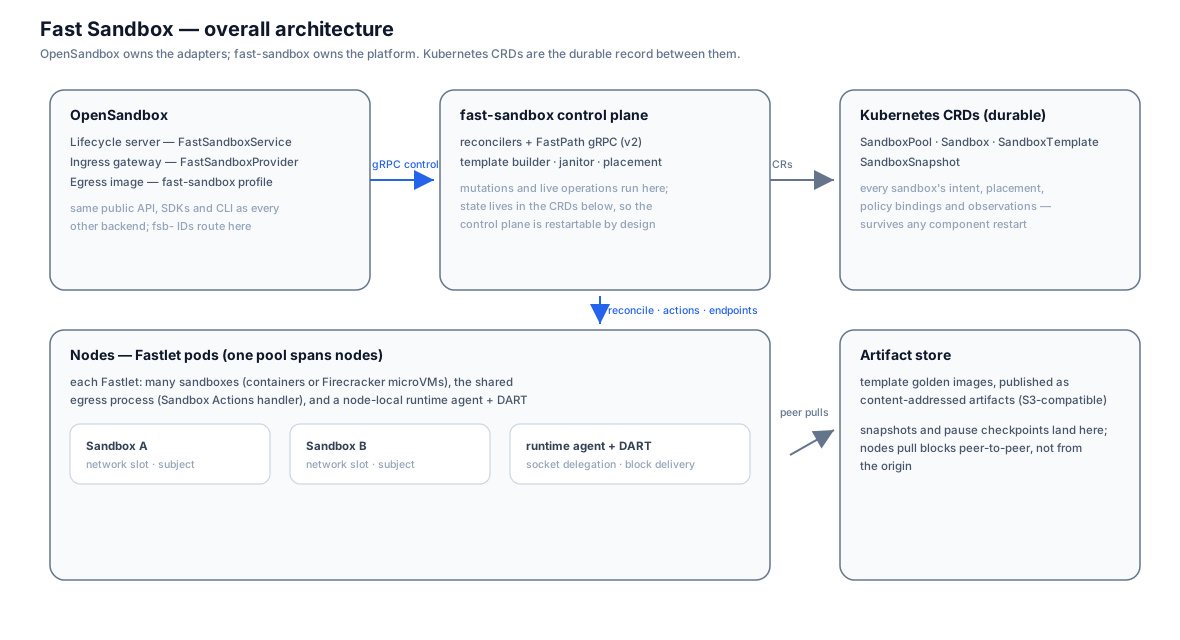
Core components
| Component | Responsibility | Design goal |
|---|---|---|
| FastPath (gRPC control plane) | Serves every mutation and live operation: create, update, expiry, endpoint resolution, snapshots | Constant-time create via in-memory placement; restartable because durable state lives in CRDs, not here |
| Reconcilers (controller) | Drive CRs to reality: build templates, run pools, place sandboxes, finish snapshots | Converge by observation — no leader election, replay from CRs after any restart |
Sandbox CRDs (sandbox.fast.io) | Durable record of intent, placement, policy bindings, and observations per sandbox | Intent survives every component failure; the CR is the source of truth |
| Fastlet (pre-warmed pod) | Hosts many sandboxes in one network domain; provides runtime capacity and shared services | Density with isolation: pre-provisioned network slots, shared egress and DNS amortized across sandboxes |
| Runtime agent (per node) | Owns Firecracker VM lifecycle over a unix socket; node readiness checks and self-labeling; installs assets | Node autonomy: the control plane delegates, the node verifies itself before admitting workloads |
| DART (per node) | Peer-to-peer artifact delivery between node state roots | Amortize the origin: each block fetched from the store roughly once cluster-wide |
| Egress process (per Fastlet) | Multi-sandbox outbound policy: subjects, Sandbox Actions handler, DNS and network enforcement | Fail-closed per-sandbox policy without per-sandbox sidecars — policy may be late, never open |
| Template builder | Converts OCI images into golden-image artifacts (guest wiring, init, execd baked in) | Workload fixed before any request: creates express intent, not configuration |
| Janitor | Sweeps orphaned resources of failed operations | Reconciliation finishes interrupted work; the janitor removes what should no longer exist |
Design principles
- No new public API: template-based creation and
fsb-ID dispatch ride the existing lifecycle contract. SDKs work unchanged across backends, and no sandbox-to-backend registration store exists — the ID prefix is the dispatcher. - CRD-first control: durable per-sandbox intent lives in
sandbox.fast.ioresources; FastPath gRPC carries the mutation hot path. The Kubernetes scheduler, watch propagation, and kubelet leave the create path — the durable write does not. - Fail-closed multi-tenant egress: every subject denies traffic from registration until its data plane is ready — policy delivery can be late, never early-open.
- Authenticated routing: sandbox routes are signed
f1.scopes verified at ingress; endpoint issuance is decoupled from readiness. - MicroVM-ready: one integration serves container and Firecracker golden images, selected by template rather than by request.
Documentation
| Page | Content |
|---|---|
| Templates | Template catalog, golden-image builds, artifact publication |
| Scheduling | Pools and Fastlets, the create hot path, lifecycle and pause/resume |
| Networking | Network slots, inbound route scopes and resolution, outbound egress enforcement |
| Pause, Resume, and Snapshots | Checkpoint artifacts, pause/resume across Fastlets, snapshot publication and restore |
| High Availability | What survives which failure: control plane, nodes, sandboxes |
| Storage | Artifact store, peer-to-peer block delivery, node state roots |
| Firecracker | Host requirements, per-VM networking model, agent delegation |
| Performance | Measured create, boot, and pause/resume characteristics |