
Networking
Fast Sandbox traffic flows through two adapters in this repository:
- Inbound (client → sandbox): the ingress gateway's
FastSandboxProviderverifies signed route scopes and forwards traffic to the Fastlet through FastPath endpoint resolution (components/ingress/). - Outbound (sandbox → external): one shared egress process per Fastlet pod enforces per-subject policy for N sandboxes, driven by the Sandbox Actions protocol (
components/egress/).
Design highlights
- Authenticated scopes instead of raw routing keys: a route is a signed
f1.scope binding tenant namespace, sandbox ID, and port. The ingress verifies before it routes; there is no unauthenticated path to a sandbox. - Lazy resolution: the upstream address resolves only when traffic arrives, so routes stay valid across Fastlet rescheduling without an invalidation protocol.
- Fail-closed egress: every subject denies traffic from registration until its data plane is ready — policy delivery can be late, never early-open.
- Policy as data: egress policy rides the Sandbox CRD's revisioned
actionBindings; only credentials travel out of band, memory-only. - One dispatch point: DNS filtering and network enforcement are shared pod-netns services, dispatched per packet by source IP.
Inbound: route scope to Fastlet
Route scopes
A Fast Sandbox route is an authenticated scope, not a plain host or path. The server signs the tenant namespace, sandbox ID, and port with the opensandbox-fsb-route-v1 scheme; the f1. prefix identifies the scope format version, and the ingress shares the server's signing key ring.
- Header mode expresses the scope as an
OpenSandbox-Ingress-Toheader; URI mode encodes it in the path. - Wildcard-host scopes are deliberately unsupported: namespace, sandbox ID, and MAC do not fit safely in one DNS label.
- Clients must preserve the returned route and headers verbatim — the scope is the credential.
The server issues these routes without calling FastPath or waiting for readiness: signing the tenant namespace, sandbox ID, and port is a local operation keyed by the shared ingress key ring. Issuance is therefore decoupled from sandbox state, and endpoint discovery never proves existence — the ingress resolves and verifies when traffic arrives.
Endpoint resolution
The ingress resolves the upstream address through the FastPath ResolveEndpoint RPC when a request arrives. Resolution returns the target endpoint, the proxy address to forward through, and any required headers.
Failure semantics are part of the contract:
- A
FailedPrecondition— including a not-yet-published route — surfaces as503withRetry-After. It is never reported as a missing sandbox: the ingress must not leak the difference between "not ready" and "does not exist". - The policy port (
18080) is resolvable for SDK compatibility but returns501for traffic; policy operations belong to the server's network policy route, not the data path.
Access modes
| Mode | Path | Trade-off |
|---|---|---|
direct-fastlet-proxy (default) | Ingress → Fastlet pod directly | Lower latency; requires ingress to reach Fastlet pod IPs |
central-proxy | Ingress → fast-sandbox central proxy → Fastlet | No pod-IP reachability requirement; extra hop |
Direct mode bypasses the central proxy, so the pod network must restrict Fastlet data-plane ports to trusted ingress workloads, and FastPath must admit the ingress namespace when the two systems deploy separately. The mode is chosen per deployment, not per request.
Transport and interoperability
The ingress speaks only the ResolveEndpoint subset of FastPath v2 at a pinned wire revision shared with the server's generated client, so the components stay interoperable as fast-sandbox evolves. gRPC transport is plaintext; isolation between ingress, Fastlets, and FastPath is a deployment concern (network policy), with TLS deferred until both sides support it.
Outbound: one egress control plane, N subjects
Fastlet pods host many sandboxes in one network domain, so the per-sandbox egress sidecar does not apply. The egress component runs the opt-in fast-sandbox profile (OPENSANDBOX_EGRESS_PROFILE=fast-sandbox): one egress process per Fastlet pod serves N sandboxes as independent subjects, each with its own policy, credentials, and kernel rules. The default sidecar profile is unchanged; the two profiles are mutually exclusive deployment forms.
Policy reaches subjects as data: the server writes it to the Sandbox CRD's revisioned actionBindings through the shared lifecycle policy route, with sidecar-compatible semantics — replace is total, merge follows sidecar rules (same-target rules replace in place, first per target wins), removal is by target and idempotent. Writes are fenced by sandbox UID and generation (409 on a lost race; other tenants are indistinguishable from missing, 404), and a successful write commits intent only — enforcement converges on the Fastlet asynchronously, and a cleared binding resets the subject to deny-first.
Network slots
Each sandbox is pre-provisioned with a network slot in the Fastlet pod netns before it exists: netns, veth, and masquerading are set up ahead of any create request, and the attachment identity ships in the SET_BINDING envelope. A sandbox never waits for network setup, and egress can enforce policy from its first packet.
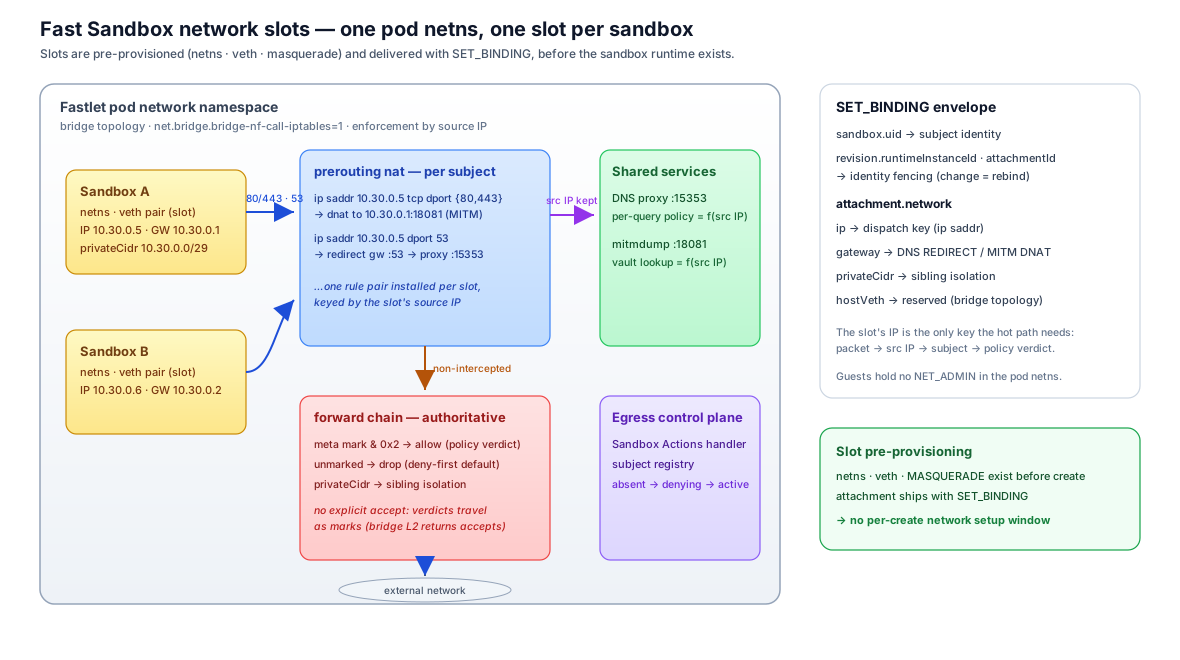
The slot's IP is the dispatch key: the shared DNS proxy selects the subject for each packet by source IP, so one service per Fastlet serves every sandbox with per-subject policy.
attachment.network field | Role |
|---|---|
ip | Dispatch key — ip saddr matches select the subject's rules |
gateway | Target of the DNS REDIRECT |
privateCidr | Sibling-isolation rules between sandboxes |
hostVeth | Reserved — on the bridge topology, policy hooks see the bridge device, not the veth |
Subject lifecycle
A subject is the unit of policy, credential, and rule ownership — one per sandbox, identified by the sandbox UID. The egress process maintains a per-subject state machine:
absent ──SET_BINDING──► denying ──data-plane-ready──► active
   ▲                        │                            │
   └──────REMOVE_BINDING────┴────────────────────────────┘
Subject lifecycle and policy are delivered by the Fastlet over the public Sandbox Actions Handler protocol (sandbox.fast.io/actions/v1). The egress process is the handler; two Pod-loopback HTTP endpoints serve it:
POST /_fastlet/v1/actions—SET_BINDING,LIFECYCLE_HOOK,REMOVE_BINDING.GET /_fastlet/v1/actions/status— process incarnation probe. A changedinstanceIdmakes the Fastlet replay the latest binding and all reached hooks.
Every operation carries fencing fields (runtimeInstanceId, attachmentId) so a control-plane reset can never look like a rebinding. Unknown protocol versions, operations, or hook names are validation errors and are never silently ignored.
Credential delivery
Credential vault revisions are pushed by the server over fast-sandbox's proxy-route mechanism and routed per subject by the X-Fast-Sandbox-Uid header. Pushes stay memory-only in egress — no Secret volumes, no disk state.
- A push for a UID whose binding has not appeared yet is cached briefly and applied on registration.
- A push carrying a mismatched
X-Fast-Sandbox-Generationis discarded.
Enforcement
Enforcement is nftables in the Fastlet pod network namespace, dispatched by source IP — the attachment block of each action envelope supplies the subject's IP, gateway, host veth, and private CIDR.
- DNS: one shared proxy on loopback
127.0.0.1:15353. Per-subject prerouting REDIRECTs forward sandbox DNS addressed to the attachment gateway, preserving the source IP so per-query policy dispatches to the right subject. - Forward path: per-subject
hook preroutingchains mark allowed destinations (meta mark 0x2); the master forward chain drops unmarked traffic. The path deliberately never emits an explicitaccept— withnet.bridge.bridge-nf-call-iptables=1(the fast-sandbox bridge topology) an accept verdict returns the frame to bridge L2 and is lost. - Dynamic sets: DNS-learned IPs get bounded leases; a per-subject connection refresh loop renews leases of active TCP connections. UDP/QUIC relies on DNS TTLs.
- Encrypted DNS: DoT (853) is always dropped; optional DoH-over-443 blocking applies globally to every subject.
- Atomicity: static sets are swapped atomically; on restart the egress wipes stale rules, publishes a new
instanceId, and the Fastlet replays every live binding.