
Egress
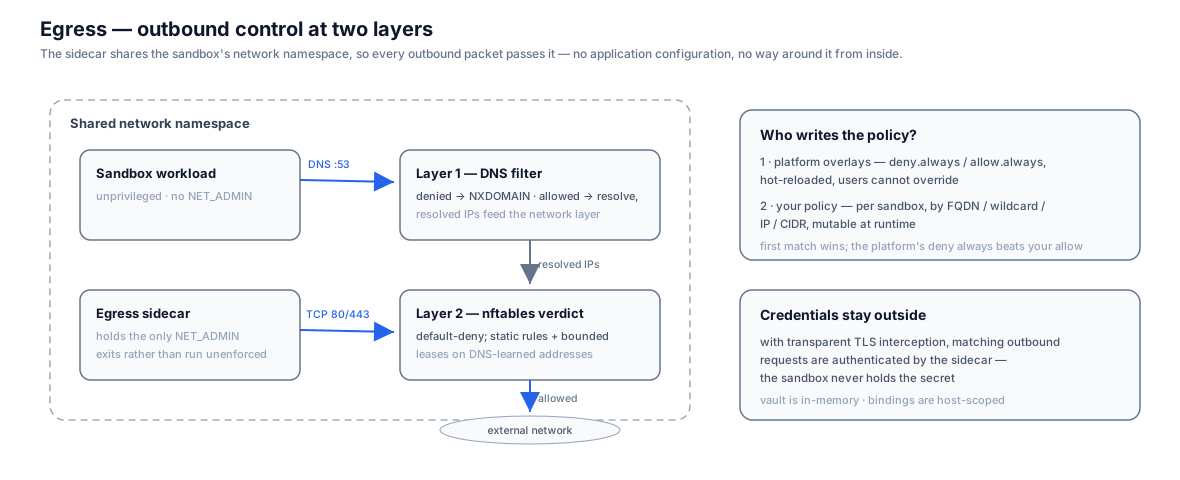
Egress is how a sandbox gets a network policy instead of open internet access. It runs as a sidecar sharing the sandbox's network namespace, so every outbound packet passes it — no application configuration, and no way around it from inside the sandbox. Policy is declared at create time (networkPolicy) or by the platform, and enforced continuously.
Capabilities at a glance
| Capability | What you get |
|---|---|
| FQDN rules | Allow or deny by domain, wildcard (*.pypi.org), IP, or CIDR |
| DNS filtering (default) | Denied domains fail resolution; allowed ones resolve normally |
Network enforcement (dns+nft) | Strict default-deny at the packet layer, fed by DNS-resolved addresses with bounded leases |
| Platform overlays | Operator-set deny.always / allow.always floors that user policy cannot override |
| Credential Vault | Secrets stay in the sidecar; credentials are injected into matching outbound requests |
| Transparent TLS interception (L7) | See, control, and authenticate outbound HTTPS — production-usable mechanism, experimental configuration surface |
| Fail-closed startup | If enforcement cannot be installed, the sidecar exits — it never runs as a no-op |
How interception works
Layer 1 — DNS. All port-53 traffic is redirected into the sidecar's DNS proxy. A denied domain answers NXDOMAIN; an allowed domain resolves through to the real upstream, and its resolved addresses are recorded.
Layer 2 — Network (dns+nft mode). nftables drops everything not explicitly allowed. Allowed traffic passes by static rule or by DNS-learned address sets: a resolved IP receives a bounded lease (with a grace window for active TCP connections), so "allowed" never silently becomes "allowed forever". UDP and QUIC flows rely on DNS lease timing alone.
Precedence. First matching rule wins, in this order: platform deny.always, platform allow.always, then your policy — so the platform's deny always beats your allow. The overlays live in files inside the sidecar image and hot-reload every minute. A reload publishes the parsed pair only after the corresponding nftables static policy is accepted; parse or apply failures keep the active in-memory rules and remain eligible for retry. Your policy is set per sandbox and can be mutated at runtime (add, replace, remove by target) through the API the SDKs expose.
Design decisions
Enforcement lives in the data path, not beside it. The sidecar shares the sandbox's network namespace and installs redirect rules there, so every packet passes the policy engine without application cooperation — and without the option to bypass it, because the workload holds no NET_ADMIN in that namespace.
Two layers, two costs. DNS filtering alone is cheap and universal, but it only gates names: an application that obtains an address by other means is not covered. The dns+nft layer adds packet-level truth — default-deny with DNS-learned exceptions that carry bounded leases (renewed while a TCP connection is active), so "allowed" never quietly becomes "allowed forever".
Encrypted DNS is treated as an escape hatch. Filtering plaintext DNS is void if the workload can resolve over HTTPS: DoT (853) is therefore always dropped, and blocking DoH over 443 is a one-switch option.
Fail-closed over best-effort. If the redirect rules cannot be installed, the sidecar exits instead of running as a silent pass-through; a supervisor restarts it with backoff and a crash-loop breaker. "No enforcement" must never look like enforcement.
Portable by fallback, honest about limits. Redirects install through iptables where available and fall back to native nftables on kernels lacking the required extensions (Firecracker-style guest kernels). gVisor's netstack cannot support this mechanism — Kata is the supported secure runtime — and transparent service-mesh sidecars conflict by construction, since both rewrite the same namespace's outbound traffic. These boundaries are explicit, not best-effort.
Transparent TLS interception (L7)
Layers 1 and 2 decide whether a connection may happen; the transparent MITM layer adds control and visibility over what goes through it. When enabled, outbound HTTP and HTTPS is redirected into a mitmproxy listener inside the sidecar, which recovers the true destination from connection state and terminates TLS on the sandbox's behalf.
Status: experimental but production-usable. The interception, credential-injection, and CA-delivery mechanism is complete and runs in production settings; what remains experimental is the configuration surface — extra ports and diagnostic switches may still change between releases.
Internal OSEP-0023 bootstrap gate
OPENSANDBOX_EGRESS_EXPERIMENTAL_REVISION_RUNTIME=true is a development-only, sidecar-profile gate for the OSEP-0023 revision protocol. Each mitmdump launch or restart receives a fresh authenticated process session and must acknowledge the current in-memory Vault snapshot (or the authoritative initial empty state) before health becomes ready. The default is off.
This gate does not enable credential-bound TLS selection. Existing traffic still uses intercept-all behavior and the conditional active-Vault lookup; connection fencing, Fast Sandbox, and the public interceptionMode contract are not wired to the revision protocol yet. To prevent the acknowledged bootstrap snapshot from diverging from the in-memory Vault, POST, PATCH, and DELETE on /credential-vault return 503 while this internal gate is enabled.
Trust is delivered, not disabled. The sidecar exports its CA, and the sandbox bootstrap installs it into the system, NSS, and JDK trust stores on a best-effort basis — clients keep certificate verification on (curl without -k), and traffic stays encrypted end-to-end from the sandbox's point of view. Images that run Chromium-family browsers should ship the native certutil package so the per-user NSS store can be updated.
What it enables:
- Credential Vault — injection happens when request headers are read, so it applies regardless of body size, including fully streamed uploads.
- TLS-level observability — optional request-level outcome metrics (decrypt / passthrough) for targeted diagnostic windows.
Extendable at L7: custom mitmproxy addons. The interception layer is not closed. The sidecar always loads its bundled system addon first, then any additional mitmproxy addons listed — comma-separated — in OPENSANDBOX_EGRESS_MITMPROXY_SCRIPT, in the order given. Addons are standard mitmproxy scripts with access to the full L7 hook surface: hostname, HTTP method, URI path, headers, and bodies of every intercepted request and response. Operators can therefore build a custom egress image that adds arbitrary L7 policies on top of the built-in FQDN and credential machinery — fine-grained hostname, method, URI, or header filtering, custom header injection, request rewriting — as ordinary Python addons. The system addon keeps its position ahead of user addons, so the built-in behavior is fully in place before any custom logic runs.
Chained upstream proxy. Setting OPENSANDBOX_EGRESS_UPSTREAM_PROXY to http://host[:port] or https://host[:port] on the egress container chains all mitmproxy-handled egress through that proxy via CONNECT, optionally with OPENSANDBOX_EGRESS_UPSTREAM_PROXY_AUTH (a complete Proxy-Authorization header value). The endpoint accepts only a host and optional port (or a single / path); credentials, query, fragment, and other paths are rejected, and validation errors do not include the supplied URL. The CONNECT authority is the SNI/Host-derived FQDN when known. This is fail closed: pass-through flows that cannot be chained (no-SNI, ignore_hosts/tcp_hosts/udp_hosts matches, UDP) are refused rather than sent direct. Chaining requires transparent MITM and dns+nft enforcement, and is not supported under the fast-sandbox profile — invalid combinations fail startup before the proxy hostname is registered for infrastructure DNS. Under dns+nft, the proxy endpoint is reachable only from the mitmproxy process (UID-, IP-, and port-scoped nft rules), never through the sandbox allow sets; hostname endpoints resolve through an infrastructure DNS path that bypasses sandbox policy evaluation. Literal proxy IPs remain permanently seeded in those scoped sets; DNS-learned addresses use explicit bounded TTLs. On Docker and Kubernetes, administrators configure it via the server's [egress.upstream_proxy] section — see server configuration.
Scope notes:
- Ports 80 and 443 are always intercepted; a bounded list of extra ports can be added. Vault binding matching currently fires on 80/443 only — extra ports are decrypted and logged but not credentialed.
- IPv6 destinations are intercepted alongside IPv4 (listeners and redirect rules cover both address families).
- A not-yet-initialized proxy is visible in health: the sidecar answers
503 mitmproxy not readyrather than passing traffic unexamined. - One known upstream behavior: an SSE body larger than ~1 MB can be truncated when the origin closes the connection with a TCP RST mid-body — standard TCP semantics, not an interception bug. See Egress SSE Truncation.
Credentials without secrets in the sandbox
With transparent TLS interception enabled, the sidecar can inject credentials into outbound requests that match a vault binding — bearer tokens, basic auth, API keys, or custom headers. The vault lives in the sidecar's memory only: the sandbox workload sees authenticated traffic but never holds the secret itself. See Credential Vault.
Where it runs
| Deployment | Shape |
|---|---|
| Docker | A separate sidecar container; the sandbox joins the sidecar's network namespace |
| Kubernetes | The sidecar is appended to the sandbox pod and holds the pod's only NET_ADMIN |
| Pooled sandboxes | Pre-warmed pods cannot gain a sidecar per request — put required controls in the Pool template (per-request networkPolicy + pool references are rejected) |
| Fast Sandbox | A shared egress process per Fastlet pod, one subject per sandbox — see Fast Sandbox: Networking |
Service Mesh Compatibility
Not supported with transparent mesh sidecars
Egress is designed to be the only transparent outbound interception layer in the sandbox's network namespace. Deployments that inject a service-mesh sidecar (Istio/Envoy and similar) into the same pod are not currently supported for egress features.
Both layers rewrite outbound traffic in the same namespace, so per-sandbox policy, transparent MITM, and Credential Vault cannot be relied on alongside mesh injection. Prefer excluding sandbox pods from mesh injection, or enforce outbound policy with a CNI-level mechanism instead. The same constraint applies to gVisor: its netstack does not implement the redirect mechanism egress requires — use a Kata runtime, which provides comparable isolation and full egress support (see the compatibility matrix).
Shutdown
On shutdown, the sidecar keeps DNS and network rules working while in-flight deliveries finish (a bounded window), then removes its network rules and flushes telemetry. Delivery is best effort — forced termination can drop events. Under Docker, deletion gives the sidecar a 9-second stop budget before forced termination; see Docker deletion. A lightweight supervisor restarts the sidecar on crash with exponential backoff and a crash-loop breaker, and cleans stale redirect state before a fresh start.
Observability (OpenTelemetry)
When the platform configures an OTLP endpoint, the sidecar exports per-sandbox metrics: denied request counts, DNS query outcomes (denied-by-policy and resolver-failure are deliberately separate counters — alerting on the wrong one inverts the diagnosis), nftables update failures, and process resource usage. Cardinality is bounded: no queried domain or destination ever becomes a label. See the egress OpenTelemetry reference and component telemetry.