
Auto-Pause and Wake-on-Access
Fast Sandbox sandboxes occupy their full CPU and memory allocation for as long as they live, and agent workloads are idle most of that time. Auto-pause and wake-on-access turn the existing checkpoint machinery into an automatic cycle: a sandbox that opts in is paused after X seconds without ingress traffic, and the next request to it wakes it — the gateway parks the request for up to a budget Y while the sandbox restores, then forwards normally. Both halves default to off; scope is the fast-sandbox backend only.
Full proposal: OSEP-0024. Enablement and configuration: the user guide.
Lifecycle
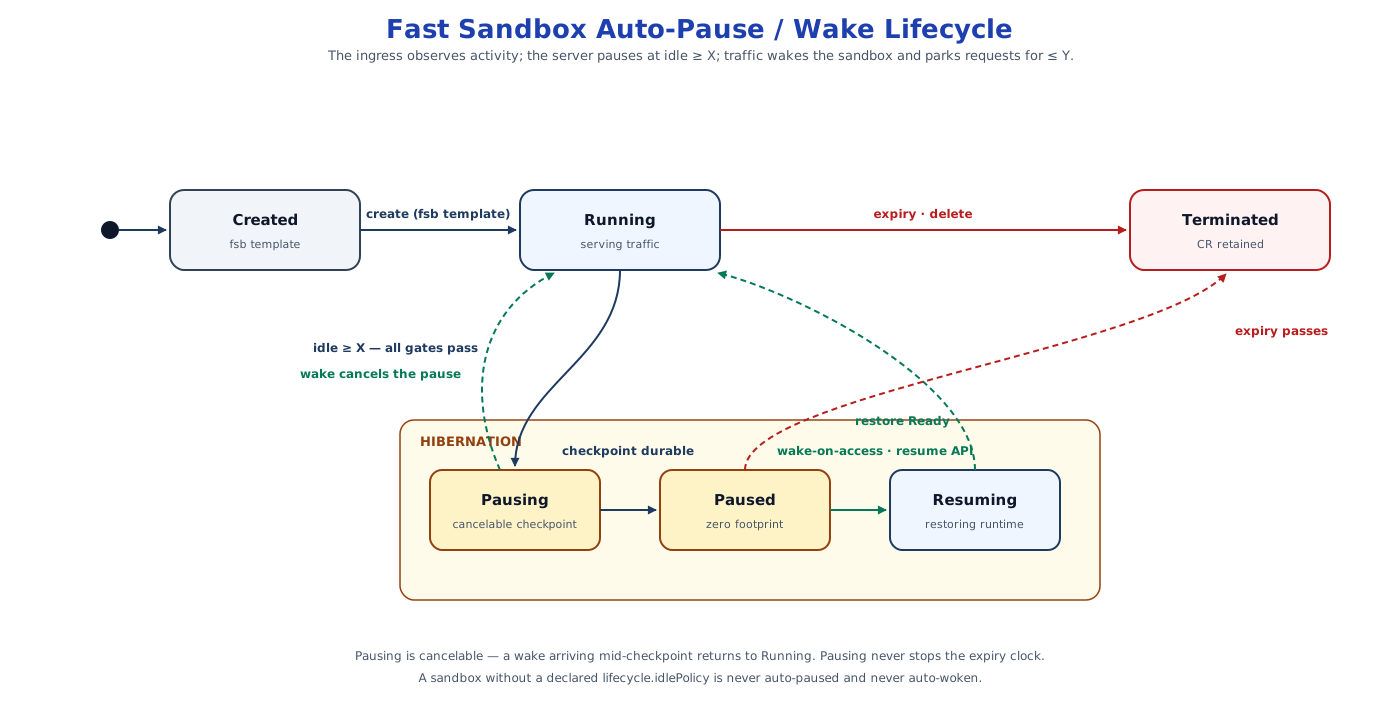
Three properties of this state machine carry most of the design:
- Pausing is cancelable. A wake arriving mid-checkpoint flips the sandbox back to
Running— a wrongly-timed pause never completes. - Pausing does not stop the expiry clock. A paused sandbox whose
expires_atpasses becomesTerminated(CR retained) and wake then fails fast with404. - Absence of policy is a hard no-op. A sandbox that never declares
lifecycle.idlePolicyis never auto-paused and never auto-woken, regardless of deployment flags.
Design principles
- One observation point. All client traffic transits the ingress, so it is the only activity producer and the only wake authority. What the ingress cannot see does not keep a sandbox alive;
activeProbeis the single app-declared exception. - Desired state over coordination.
PauseSandbox/ResumeSandboxare idempotent CAS patches on the Sandbox CR. Pause needs only a per-sandbox lock (checkpoints must not double-run); wake needs none — duplicate resumes converge because the restore is driven byspec.state, not by callers. - Three-party activation. Server config, ingress flags, and the per-sandbox policy must all agree. An unreadable or malformed policy is treated as absent — never as an implicit opt-in.
- Fail-safe direction. Redis down → no pauses (wake does not use Redis). Missing activity key → unknown, tombstoned: data loss can delay a pause, never accelerate one. Any pause failure leaves the sandbox
Running. - Bounded wake. One resume flight per sandbox per replica (singleflight); a parking lot and restore permits admit before any RPC; budget exhaustion answers
503 + Retry-Afterand never cancels an in-flight restore. - Provenance-gated replay. The gateway-owned
OpenSandbox-Wake: expiredmarker proves a request was never forwarded — only marked responses are SDK-auto-retried; post-forward re-entry retries idempotent methods once, everything else keeps today's503.
How it works
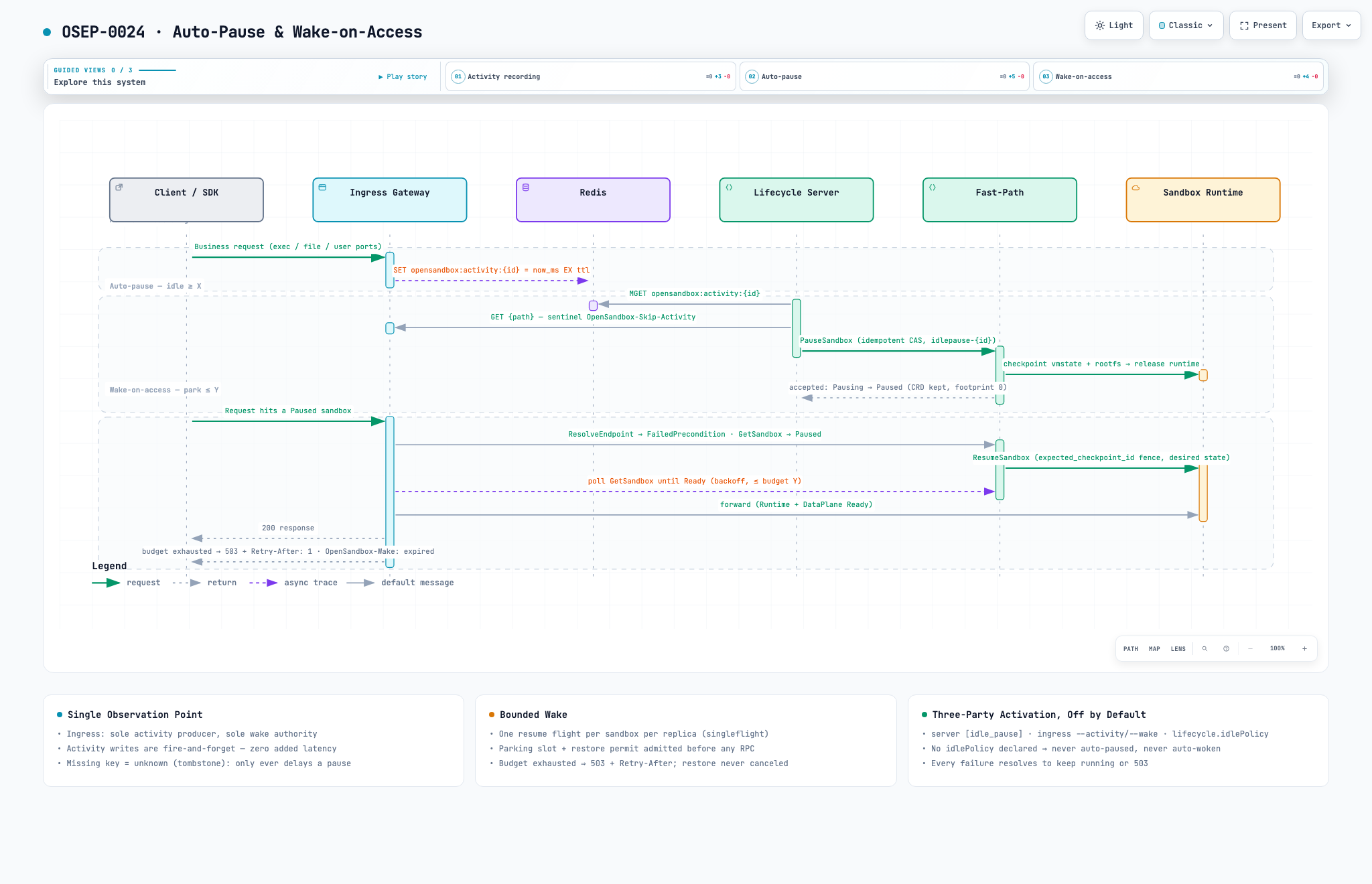
👉 Interactive sequence diagram — walk the three phases with guided views, theme switching, and relationship tracing.
Observe. Every proxied request produces one activity observation: SET opensandbox:activity:{id} = now_ms EX ttl, a monotonic-max write issued asynchronously and coalesced per sandbox — fire-and-forget, never on the forwarding hot path. Create and resume write immediately, so the idle clock starts at the latest lifecycle transition. Since X ≤ activity_ttl_seconds is enforced at create time, a present-but-stale key is idle by value; a missing key is resolved by tombstones, not assumptions. A sandbox that declares activeProbe adds a pull-mode producer: when the sweeper is otherwise ready to pause, it probes the app through the gateway (sentinel-carried, never counted as activity) — a busy answer is recorded as ordinary activity, an explicit not-active lets the pause proceed, and any failure drops the candidate.
Pause. Each server replica sweeps every sweep_interval_seconds: enumerate Running sandboxes, batch-read activity keys, then apply the gates in order — opt-in annotation → Running → idle ≥ X → not expired → NX lock → re-verify → probe. Surviving candidates get PauseSandbox (idempotent CAS). There is no leader election: the lock admits one replica per idle episode and idempotency absorbs lost races, so a crashed replica leaves no stuck state. The worst case of the whole subsystem is a missed pause.
Wake. A request whose route resolution reports FailedPrecondition (or that surfaces a stale-route error) reads the sandbox state and policy; Paused/Pausing/Resuming start or join a resume flight. The flight — one per sandbox per replica — issues ResumeSandbox fenced on expected_checkpoint_id, parks its requests, and polls GetSandbox with backoff until Ready or budget Y. Parked requests hold no upstream connection; WebSocket upgrades complete after wake. Budget exhaustion answers the wake-timeout contract while the restore converges in the background — the next request is served on the fast path.
Failure behavior
| Failure | Outcome |
|---|---|
| Redis unreachable | Sweeps skipped — no pauses; wake unaffected (no Redis on that path) |
| Redis data loss | Tombstone ⇒ pause delayed by ≥ X from first observation, never accelerated |
| Replicas race to pause | Lock + idempotent CAS ⇒ exactly one pause per idle episode |
| Resume races a re-pause | expected_checkpoint_id fence ⇒ Aborted; the flight restarts within budget |
| Slow (cross-node) restore | Budget Y bounds the client; 503 + Retry-After while the restore continues |
| Burst to many paused sandboxes | Lot + permits bound; overflow shed before any ResumeSandbox |
Security
The ingress gains exactly two FastPath calls on the channel it already holds (GetSandbox, ResumeSandbox) plus one read-only Kubernetes grant to read the idle-policy annotation. It can never pause. Parking happens after the existing host/route-scope/signature verification, so wake is reachable only for sandboxes a client can already address.
Observability
The loop exposes wake flights, park wait durations, shed count, active restores, dropped activity writes, and probe outcomes. The flap ratio (pauses followed by a quick wake — the primary tuning signal for X) is derived per sandbox from pause and wake telemetry. See the Telemetry guide.
References
- User guide — enablement,
idlePolicyreference, SDK retry behavior, tuning. - Ingress — the observation point and wake authority.
- Fast Sandbox: Pause, Resume, and Snapshots — the checkpoint machinery this loop automates.
- OSEP-0024 — full proposal, alternatives, and test plan.